
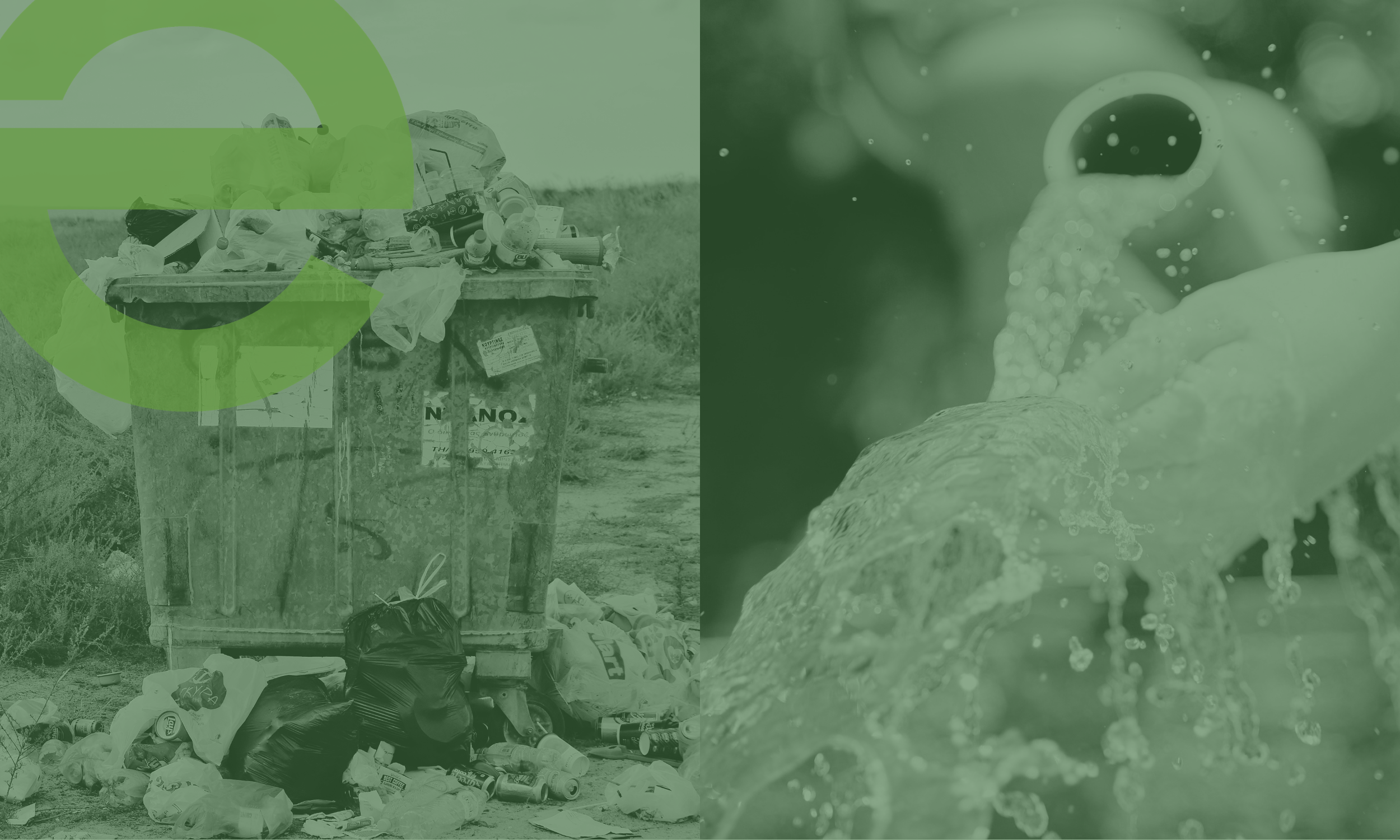
This year's World Green Building Week theme, #BuildItReady, puts climate change and business resilience front and centre. The Green Building Council South Africa (GBCSA) frames it around three pillars: resilience, efficiency and opportunity. With National Recycling Day and World Water Monitoring Day also falling in September, this piece looks at how your office can better manage the water, energy and waste moving through your building.
A waste crisis measured in landfill years
South Africans generate an estimated 122 million tonnes of waste every year, and only around 10% of it gets recycled, according to Mpact Recycling. The shortfall shows up the most dramatically at the landfill. AfriForum's 2025 Landfill Site Audit inspected 169 municipal sites across the country and found that only 22%, or 38 sites, met the basic minimum requirements for responsible waste management. In Gauteng specifically, the same audit warned that the province's active municipal landfills will reach maximum capacity in under four years if current trends continue. This is the direct, physical consequence of what gets thrown away (and how) multiplied across millions of households and businesses.
A water crisis measured in litres never billed
Water follows a similarly stark pattern mapped out by the Department of Water and Sanitation's 2025 Green Drop and 2026 No Drop report. It puts the national non-revenue water rate at 47.3%. That means close to half of the water South Africa treats and pumps never reaches a paying user or generates any revenue. Water and Sanitation Minister Pemmy Majodina told Parliament in 2026 that this amounts to more than 2.1 billion kilolitres lost annually, worth an estimated R26 billion, with physical leakage alone accounting for 32% of the total system input volume. In eThekwini, the non-revenue water rate climbs to 65% as of June 2026, against a backlog of roughly 12,000 reported leaks. Stats SA's General Household Survey found that 56.8% of households experienced water interruptions in 2025. The country's dams are, for the most part, at healthy levels. But rising drought risk and ageing infrastructure put us at heightened risk.
While government is managing the risk at a national and municipal level, there are still interventions that can be introduced and managed at a business level. A business can control, completely and immediately, what happens inside its own four walls - managing how much and how efficiently it uses water and energy, what gets thrown away, and where that waste goes next. This is the case for treating the office, and the building more broadly, as one of the most direct and underused levers a business has for managing resources. It is also the starting point for most of the consulting work we do with clients, because the built environment is exactly where national resource pressure and daily operational decisions meet.
Rethinking your approach to waste, water and energy
Refuse, reduce!
The most effective waste interventions inside an office rarely start with a recycling bin; they start earlier, with refusing and reducing. Challenge the throwaway culture built into so much of how offices operate: buy quality products designed to last rather than defaulting to disposable ones, and treat equipment with enough care that it doesn't need replacing. Practical, everyday swaps make the biggest dent here: keep reusable shopping bags on hand for errands, encourage staff to bring their own coffee mugs instead of reaching for disposable cups, and avoid single-use items like straws and packaging wherever there's an alternative.
The same thinking extends to how offices buy and print. Go paperless where you can, and when printing is unavoidable, use recycled paper. Buy eco-friendly products in bulk rather than smaller, more wasteful quantities. For uniforms or branded clothing, favour second-hand or locally made, sustainable options over fast fashion. And before throwing anything out, ask whether it can be reused or repaired first.
Separate Waste
Practical steps follow, including separating waste at source into clearly labelled streams. This could be as simple as separating wet and dry waste. Or, ideally, further separating into waste streams like paper, glass, metal, plastic and non-recyclables. Eco-bricking can further reduce what cannot be recycled from going to landfill. By compacting non-biodegradable, non-recyclable waste into plastic bottles, this waste can be diverted to local building projects instead of a landfill queue.
Tackle Food Waste
Food waste deserves particular attention in an office context. The CSIR's 2024 national study found that South Africa loses an estimated 10.3 million tonnes of edible food every year, equivalent to 45% of the country's available food supply, with processing and packaging responsible for 49% of that loss and post-harvest handling adding a further 19%. Wits University's December 2025 research valued that wasted food at R8.7 billion, food that then decomposes in landfill and produces methane roughly 80 times more potent than carbon dioxide. An office kitchen that encourages portion planning, donates surplus, and composts what is left over through a bokashi bin or a small worm farm addresses a waste problem and a climate problem in the same gesture, using the same kitchen system.
Go low–flow
Water interventions tend to be less visible but are often cheaper to implement. By installing low-flow aerated fittings, you can take a tap from around 12 litres a minute down to as little as 1.3, a reduction most people using the building will not notice day to day. Grey water, the relatively clean runoff from hand basins and dishwashing, can be redirected toward toilet flushing or irrigation instead of running straight to the drain. And because physical leaks account for roughly a third of South Africa's non-revenue water volume nationally, a building's own leak-checking routine is a great intervention option. As it is a smaller-scale version of the exact problem the country is failing to solve at the municipal level, and one a facilities team can fix.
Save on your electricity bill
Energy interventions are also a great option for offices looking to introduce sustainable interventions. HVAC systems account for up to 60% of electricity use in South African commercial buildings, according to Engico's 2026 Gauteng commercial buildings guide, making cooling and heating schedules the single biggest lever a facilities team has.
That lever also gets more expensive by the year: NERSA approved an 8.76% tariff increase for direct Eskom customers from April 2026, with municipal customers facing a further 9.01% rise from July 2026, compounding on last year's double-digit hike. Since 7 December 2025, office buildings above 2,000 square metres in the private sector must also hold a valid Energy Performance Certificate, displayed at the entrance, giving every landlord and tenant a benchmarked starting point for improvement.
Practical steps follow from that benchmark: set HVAC schedules to match real occupancy instead of running on fixed timers, keep units serviced so they don't draw extra power to compensate for poor maintenance, switch remaining fittings to LED, and use timers or smart plugs to cut the standby draw from printers, monitors and kitchen appliances overnight. Where budget allows, rooftop solar is an increasingly realistic option for daytime office loads. However, offices that can't install their own generation can still shift geysers, dishwashers and other high-draw equipment to off-peak hours, reducing both cost and pressure on the grid.
None of this holds without encouraging and engaging the people who use the building every day, and this is where the businesses that get it right make use of behavioural interventions. This might include signage that explains why a habit is important, an employee ideas box, digital-first printing policies, and a named person accountable for the progress in each area of sustainability in the office.
Interventions as individual accountability
Individual interventions are important, but they are hard to verify and easy to let slide once the initial enthusiasm fades. This is where certification becomes a valuable tool to standardise and manage the process. A rating system turns good intentions into measured, audited outcomes. EDGE certification, for example, requires a minimum 20% saving across energy, water and embodied carbon in materials before a building can qualify. Green Star and Net Zero certification go further, with Net Zero assessing a project's impact across carbon, water, waste and ecology together rather than as separate line items. The District in Cape Town sets an incredible example by becoming the first commercial property in the city to achieve Net Zero Water certification.
The MSCI South Africa Green Annual Property Index's 2023 findings show that certified buildings used 7% less electricity and 21% less water per square metre compared to uncertified buildings over an eight-year period. That said, certification does not replace the office-level habits described above; instead, it provides a verification process and a reason to keep going.
Walking our talk
We hold ourselves to the same standard we recommend to clients. Every environmental category inside Ecolution, from water and waste to procurement, social impact and staff wellbeing, has a dedicated eco champion who tracks progress and keeps the rest of the team accountable. We offset our own scope 1, 2 and selected scope 3 emissions annually through the Walker's Recycling project, a verified local initiative that reduces emissions through waste diversion and recycling infrastructure, and in 2025 we met a carbon neutral target we set for ourselves ahead of the global 2030 net zero deadline.
Across the 512+ projects in our portfolio, our own Impact Report puts water savings at more than a million cubic metres (annually) and energy savings above 122,000 MWh, figures we publish because a consultancy asking clients to measure their impact should be willing to measure its own.
South Africa's energy, landfill capacity, and water infrastructure problems will not be resolved by installing more low-flow taps and efficient lights in offices, or by separating bins correctly. But this is exactly what World Green Building Week and #BuildItReady are about: resilience, efficiency, and opportunity. When businesses adopt these themes, they can use their building as a lever for resilience and future-proofing.
