
South Africa now has eleven consecutive years of data proving certified buildings outperform. Our Impact Report shows what that looks like in practice.
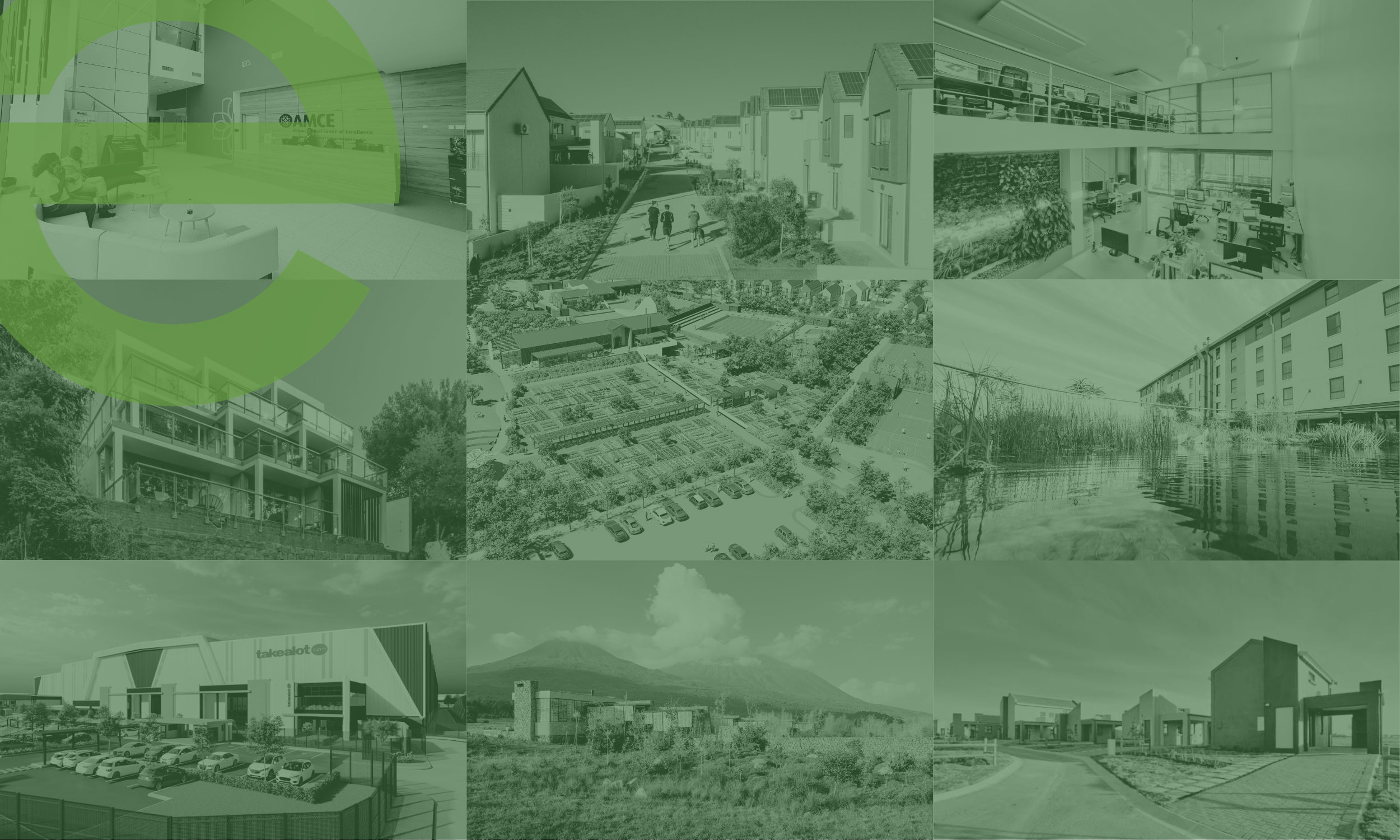
For years, it has been well understood that going green is the "right thing to do". And while the green premium has been coming down over time, this has not been enough to convince all developers of the business case for green buildings. However, the conversation has now fundamentally changed; green buildings are outperforming their conventional counterparts, and the data to prove it has never been stronger.
The data changing the narrative
The Green Building Council of South Africa (GBCSA)'s 2025 Edition of Green Building in South Africa: A Guide to Costs and Trends brings green costs and green investment returns together in a single, unified business case by drawing on a study population of 199 certified office buildings owned by 107 different companies, and combines this with data from the MSCI South Africa Green Annual Property Index drawn from the 2024 Edition of this report.
What we’re seeing more and more of is that the cost side of the equation is growing increasingly hard to argue against. The average Green Building Cost Premium (GBCP) for office projects certified between 2022 and 2024 dropped to 2.40%. This is down from a whopping 3.15% in the previous period (2019 to 2021), 3.49% in 2015 to 2018, and 5.95% in the earliest cohort of 2009 to 2014. The overall average since 2009 now sits at 3.43%. In practical terms, 56% of all projects in the study achieved a green cost premium of between just 1% and 4% of total project cost. The upfront cost of building green is becoming negligible.
But the return side is where things get increasingly more interesting.
Returns that rewrite the investment thesis
The MSCI South Africa Green Annual Property Index 2024, now covering eleven consecutive years of data since its 2016 launch, provides an independent comparison of the investment performance of green-certified and non-certified offices. In 2024, green-certified Prime and A-grade offices produced a total return of 10.1%, sitting 120 basis points above comparable non-certified assets at 8.9%. Since the index launched in 2016, certified offices have outperformed non-certified peers by a cumulative 28.2%, an annualised outperformance of 200 basis points.
The outperformance is driven by better fundamentals across every metric that matters to investors and asset managers:
Green-certified offices generate 48.3% higher Net Operating Income per square metre: R160.07/m² compared to R107.94/m² for non-certified buildings. They carry a lower vacancy rate of 11.1% versus 14.8%. Their total operating costs consume just 39% of gross income, compared to 46% for non-certified peers. And they command a 45.7% higher capital value per square metre: R22,793/m² versus R15,639/m².
This means valuers view green-certified office properties as lower-risk investments, reflected in a lower capitalisation rate of 8.58% compared to 8.94% for non-certified buildings. The green premium in income is flowing directly through to the bottom line.
The business case in Rands and cents
The 2025 report goes a step further by modelling a direct business case for green building. It compares two hypothetical 10,000 m² office buildings that are similar in every respect except that one is green-certified and the other is not. The results are striking.
The green-certified building costs 2.1% more to develop (an additional R4.8 million on a R230 million total capital outlay), driven by a 2.4% average green cost premium applied to the building cost. In exchange, it generates 67.1% higher Net Operating Income in its first year: R14.5 million compared to R8.7 million for the non-certified building.
The first-year return on investment for the green-certified building is 6.16%, compared to 3.76% for the non-certified building. That is 240 basis points higher, or a 63.7% improvement. The marginal return on the additional R4.8 million invested in green design is 120.96%. And the capitalised market value of the green certified building is 74.1% higher than its non-certified equivalent.
To put it plainly, this modest upfront investment of 2.4% on construction cost generates a return that more than doubles the non-certified building's first-year income performance, and produces a substantially more valuable asset.
Where the green Rand gets spent
Understanding where the cost premium is allocated helps shape how project teams make design decisions. The study found that 59% of the total green cost premium is concentrated in just two Green Star rating tool categories: Energy (35.8%) and Indoor Environmental Quality (23.2%). Add Management, Materials, and Water, and those five categories account for more than 88% of all green cost spending.
This tells us that the bulk of the green premium is invested in the systems that directly drive operational performance, tenant comfort, and long-term asset value. These are also building systems that lower electricity consumption, reduce water use, improve air quality, and create the kind of indoor environments that attract and retain quality tenants.
The maturity of our growing industry
South Africa's green building sector has matured significantly since the first certifications in 2009. Green design penetration, the proportion of a project's budget that includes green design elements, has been trending lower, dropping from an average of 42.7% for 2009 to 2014 projects to between 27% and 29% for projects certified in the 2022 to 2024 period. This is a positive signal that indicates the maturing industry is finding it increasingly efficient to achieve Green Star certification, requiring less budget allocation to meet the same performance thresholds.
The study also confirms that the gap between smaller and larger buildings is closing - with the earliest data set, buildings under 5,000m² faced a green cost premium of 9.3%, compared to just 2.6% for the largest buildings. By the 2022 to 2024 period, that gap had narrowed to 4.62% versus 2.43%, meaning that green building is becoming accessible at every scale.
Meanwhile, the trend of new certified buildings with a generic multi-tenant mix (rather than single corporate occupants) has grown steadily since 2011. Between 2022 and 2024, multi-tenanted buildings accounted for the majority of new certifications, and the cost premium gap between single-tenant and multi-tenant buildings has effectively disappeared.
Beware the "brown discount" trend in real estate.
The performance advantage of certified buildings is one side of the ledger, but the other is the growing risk associated with uncertified assets. A growing trend in real estate is the "brown discount", where tenants and investors actively avoid uncertified buildings, asking for discounts because they are outdated, less appealing and inefficient. Uncertified buildings face rising operational costs, retrofit liabilities, and increasing risk of market devaluation.
Buildings account for more than 15% of South Africa's Greenhouse Gas inventory. If South Africa is to align itself with a 2°C scenario, building emissions will need to decrease by 34% relative to the International Energy Agency's Reference Technology Scenario by 2050, or by 82% below current emissions. This means that most buildings will need to be at or near Net Zero Carbon. Buildings that are not on that trajectory face growing transition risk, and the market is already pricing that risk into valuations and tenant decisions.
So, how do we work together?
Our recently launched Impact Report, covering 15 years and 512 completed projects, provides further data to support what we have long observed in our industry. Green building consulting and sustainability initiatives make for an exceedingly compelling business case, and we are proud to be listed among the Green Star Accredited Professionals in the GBCSA's 2025 study. Across our 111 certifications, the developers and clients who engage us earliest in the design process consistently achieve better outcomes.
The reason is that many of the decisions that determine certification performance, and therefore long-term asset performance, happen at the concept and schematic stage. We find it challenging, if not impossible, to recover them later through documentation.
Some of our key certified projects have collectively contributed to greening 2.9 million m² of floor area, the equivalent of 414 rugby fields. At the time of writing, these projects collectively saved over 1,000,000 m³ of water annually and more than 122,000 MWh of energy per year. Those figures represent real operational cost reduction, year on year, for the owners and tenants of those buildings.
Our certification split reflects the breadth of the business case: 69.4% of our certified projects carry EDGE certification, developed specifically for emerging markets to deliver at least 20% improvement in energy, water, and embodied carbon at an accessible cost. 23.4% carry Green Star, South Africa's gold standard for integrated high-performance buildings. 5.4% are Net Zero certified, buildings that go beyond efficiency into genuine regenerative performance, and the remaining 1.8% are LEED certified, the most widely recognised international green building standard.
Our largest project category is industrial at 38.5%, followed by commercial at 31.9% and residential at 29.7%. The green building conversation in South Africa is no longer confined to glass-and-steel office towers; it now extends into warehouses, logistics facilities, and manufacturing plants as some of the building typologies where real resource-efficiency gains are being unlocked, and where the data on operational cost ratios has the most immediate impact on the bottom line.
After more than a decade of consistent outperformance on both valuations and income, as tracked by the GBSCA and the MSCI South Africa Green Annual Property Index since 2016, there can be no doubt that certified properties deliver higher returns to investors. The industry now has the local, empirical evidence to act on with confidence, and the only remaining question is whether developers, investors, and built environment professionals treat it as the strategic imperative it has become.
We believe they will. And we are excited to be there to help make it happen. If you are interested in discussing certification for your buildings, get in touch with us: https://www.ecolution.co.za/contact-us
